

Fine Art Photography for Spiritual Growth: 7 Practices
Table of Contents
- Why Fine Art Photography for Spiritual Growth Works
- 1. Contemplative Photography Techniques for Daily Practice
- 2. Creating a Sacred Space With Photography at Home
- 3. The Benefits of Visual Meditation on Fine Art
- 4. Digital or Film: Which Medium Supports the Practice
- 5. Moving Beyond Technical Skill Into the Creative Journey
- 6. Letting Mystery and the Wonder of Creation Lead
- 7. Quieting the Ego: Art, Stillness, and Inner Reflection
- Frequently Asked Questions
Last Updated: September 14, 2026
Why Fine Art Photography for Spiritual Growth Works
Fine art photography for spiritual growth works because it turns looking into a practice. When you slow down in front of a single image, you train attention, and attention is the raw material of any inner life. This guide from Magick Brush explores seven practices that make that shift possible, from five-minute seeing exercises to the prints you hang on your wall.
Most people treat spiritual growth as something you schedule: a meditation app, a retreat, a journal. Photography rarely makes the list because we think of cameras as tools for capturing, not for noticing. That assumption is the thing worth challenging first.
American Psychological Association overview of mindfulness research describes mindfulness as present-moment awareness without judgment. A camera does something similar. It forces a frame, and a frame forces a decision about what deserves your attention right now.
How a Camera Trains Perceptual Awareness
Perceptual awareness is the capacity to notice what is actually in front of you rather than what you expect to be there. A camera accelerates this because it demands a subject, a distance, and a moment. You cannot photograph everything, so you choose. That choosing is the practice.
- You slow your pace to match your looking
- You notice light before you notice objects
- You stop narrating and start observing
- You accept what the scene gives you instead of forcing it
The payoff shows up off-camera. People who practice contemplative photography often report that ordinary walks, commutes, and rooms feel less automatic.
1. Contemplative Photography Techniques for Daily Practice
Contemplative photography techniques are structured ways of using a camera to cultivate presence rather than to produce images. The goal is the quality of attention, not the quality of the shot. Five minutes a day is enough to begin.

Start with a simple sequence you can repeat without thinking:
- Stand still and take three slow breaths before raising the camera
- Name one thing you can see, one you can hear, one you can feel
- Choose a single subject and photograph only that for five minutes
- Lower the camera and look at the subject again without it
- Note one word that describes how you feel
The last step matters more than the photograph. Over weeks, those single words become a record of your inner weather.
Visio Divina: Divine Seeing in Five Minutes
Visio Divina, or divine seeing, is a contemplative practice of looking at an image slowly and prayerfully, letting it speak before you analyze it. The method borrows from an older tradition of sacred reading and applies it to visual experience.
A five-minute version works like this: choose one image, look at it for a full minute without commentary, then let your eyes rest on one detail for another minute, then close your eyes and hold the image in memory, then open them and notice what changed. Finally, sit with whatever the image stirred in you.
Harvard Divinity School resources on contemplative practice notes that contemplative traditions across cultures use sustained attention as a doorway to insight. Visio Divina is that idea applied to sight.
2. Creating a Sacred Space With Photography at Home
Creating a sacred space with photography at home means giving one wall, corner, or shelf a single intentional image and treating that spot as a place to pause. The space does not need to be large. It needs to be consistent.
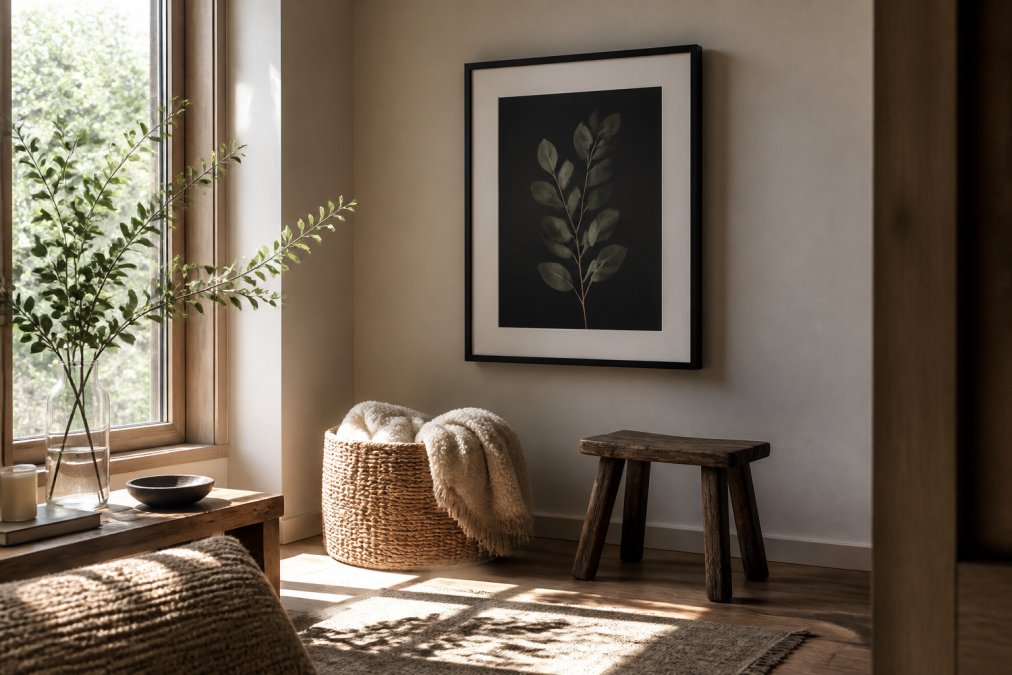
Renters have an advantage here. A print is portable, so a sacred space can move with you. No drilling, no renovation, no permission needed.
Choosing a Print That Anchors the Room
Choose a print that anchors the room by picking one image you can return to for years without tiring of it. The test is simple: look at it for two minutes and notice whether your breathing slows.
At Magick Brush, each piece is an original photograph by Erin D'Elia, printed on museum-quality archival paper. The Inward Spiral ($64.99) works well for a meditation corner, since the leaf's curl pulls the eye inward and back out again. Monarch's Pause ($57.44) suits a healing room where rest is the theme.

| Practice | Time Needed | Frequency | Best Print Style |
|---|---|---|---|
| Visio Divina | 5 minutes | Daily | Botanical or floral |
| Visual meditation | 10-15 minutes | 3-4 times weekly | Landscape |
| Sacred-space gazing | 2 minutes | Whenever you pass it | Any single anchor piece |
| Contemplative walk | 15-20 minutes | Weekly | Not applicable |
3. The Benefits of Visual Meditation on Fine Art
The benefits of visual meditation on fine art include steadier attention, lower reactivity, and a felt sense of calm that carries into the rest of the day. The mechanism is not mysterious. Sustained looking quiets the mental commentary that usually runs underneath experience.
Unlike a screen, a print does not refresh. There is nothing new to check, so the mind stops scanning for novelty and settles. That stillness is the point. A photograph of a shoreline at dusk, like Night Tide ($69.99), gives the eye somewhere soft to rest without demanding anything back.
4. Digital or Film: Which Medium Supports the Practice
Film slows the practice down in a way digital cannot, while digital makes daily repetition easier. Both work. The choice depends on which constraint helps you more, but the difference is more concrete than most articles admit, and it is the single most under-covered question in this space.
What Film Actually Changes
Film changes three things at once, and each one feeds the practice:
- Frame scarcity. A roll of 35mm film holds 24 or 36 exposures. That limit forces a decision before every press of the shutter, which is the same muscle contemplative practice builds.
- Delayed feedback. You cannot review the image on the back of the camera, so you stop judging and start looking. The gap between shooting and seeing is where attention lives.
- Physical cost. Film, processing, and scanning add up per roll, so you shoot less and think more. The friction is the feature.
Digital inverts all three. Unlimited frames, instant review, no marginal cost. That is worse for deliberation and better for repetition, which matters, because spiritual practice is built on repetition, not on perfect single frames.
A Practical Split That Works
Most practitioners who use both settle into a division of labor rather than picking a side:
| Use Case | Medium | Why |
|---|---|---|
| Daily five-minute seeing exercise | Digital or phone | Volume and low friction keep the streak alive |
| Weekly contemplative walk | Film, one roll | Scarcity forces deliberate looking |
| Seasonal or retreat session | Film, slow and planned | Delayed feedback deepens reflection |
| Visio Divina on your own images | Either, printed | The print is what you sit with, not the file |
The Printing Step Nobody Mentions
Whichever medium you shoot, the practice completes when the image leaves the screen. A file scrolls past; a print stays. That is why the sacred-space work in this guide depends on physical images rather than a camera roll. Film gets you halfway there by making you wait. Printing gets you the rest of the way by making the image permanent enough to return to.
A simple starting protocol: shoot digital for thirty days to build the daily habit, then add one roll of film per month to introduce deliberate scarcity. The contrast between the two modes is itself instructive, because you will feel your attention change the moment the frame count drops.
5. Moving Beyond Technical Skill Into the Creative Journey
Technical skill gets you a sharp image. It does not get you a meaningful one. The creative journey begins when you stop asking whether a photograph is correct and start asking whether it is honest. The useful part is what happens next: a structured way to move past the plateau that hits nearly every photographer once exposure and composition become automatic.
That plateau is real and predictable. A common pattern is roughly two to four years of steady improvement, followed by a stretch where images look competent but feel empty (apa.org). The cause is not a lack of skill. It is that technique has no opinion about what matters, so the work keeps solving problems you no longer have.
The Three-Question Reset
When you feel stuck, run every image you keep through three questions before you decide whether it stays:
- What did I actually feel when I pressed the shutter?
- Would I still make this image if no one ever saw it?
- What does this image know that I have not admitted yet?
If an image fails all three, it is a technical exercise, not a creative one. That is fine, label it as practice and move on. If it passes even one, it is doing spiritual work, and it belongs in your private archive rather than your portfolio.
Photograph What You Avoid
The fastest way off the plateau is to point the camera at what you normally edit out. The unremarkable corner. The thing you walk past daily. The subject that feels too plain to justify a frame. The more reliable instruction is to chase what bores you, because boredom is usually attention refusing to land.
A practical weekly structure:
- Days 1-3: Shoot only what you find visually uninteresting. No exceptions.
- Day 4: Review the frames and write one sentence about why each subject felt dull.
- Days 5-6: Return to one of those subjects and shoot it again, closer or slower.
- Day 7: Compare the two sets. The second set is almost always the more honest work.
Technique as a Servant, Not a Goal
None of this means abandoning craft. It means reordering it. Aperture, light, and composition are how you say something, not what you say. When the subject is chosen honestly, technique stops being a scoreboard and becomes a vocabulary. That shift is the entire creative journey, and it usually takes longer than learning the camera did.
6. Letting Mystery and the Wonder of Creation Lead
Mystery is not a problem to solve in this work. It is the material. When you stop trying to explain what you are seeing, the wonder of creation becomes available again.
The Green Passage ($74.99) captures this well. A path softened by grass and shadow does not announce its destination. It invites you forward anyway. Shadow Petals ($79.99) does something similar in black and white, turning familiar petals into pure light, edge, and structure.

7. Quieting the Ego: Art, Stillness, and Inner Reflection
Ego quiets when the image matters more than the photographer. That sounds abstract until you try it. Photograph something you cannot improve, control, or claim credit for, and notice how much of your usual mental noise was about you.
Stillness is not passivity. It is the condition that lets inner reflection happen without interference. A butterfly at rest, like Keeper of the Branch ($59.38), holds that posture without effort. It observes. It does not perform.
The practice is the same for you. Look longer than feels comfortable. Let the image be what it is. Then carry that posture into the rest of your day.
Frequently Asked Questions
What is contemplative photography?
Contemplative photography treats the camera as a tool for stillness rather than output. You slow down, notice light, texture, and small details, then photograph what genuinely holds your attention. The goal is not a perfect image but a practiced quality of seeing. Many people pair it with visio divina, a slow, prayerful looking at a single image. Over time, the habit builds perceptual awareness and inner reflection, which is why it supports spiritual growth so well.
How can viewing fine art photography aid in mindfulness and meditation?
A single image gives your attention one place to rest, which is easier than clearing your mind entirely. Try this: sit with a print for five minutes, breathe slowly, and let your eyes travel through the composition without naming anything. The benefits of visual meditation show up as a slower breath, a quieter internal monologue, and a felt sense of presence. Prints made for meditation spaces, with soft color and open composition, tend to work best for this.
Can photography be used as a tool for personal and spiritual growth?
Yes, and it works because it forces conscious participation. You cannot photograph what you have not noticed, so the practice builds observational skills and patience. A simple routine helps: shoot for ten minutes daily, review three images at night, and write one sentence about what each one made you feel. That written reflection is where the growth happens. Pieces such as Monarch's Pause, which centers on rest and renewal, can reinforce the same theme on your wall.
How do you choose art that supports your spiritual intentions?
Start with the feeling you want in the room, not the color palette. If you want calm, look for softness, open space, and slower compositions. If you want courage, look for contrast and structure. Read the artist's story too, since a real narrative behind a piece keeps the connection alive over years. Erin D'Elia's prints, including The Green Passage, each carry a written reflection, which makes it easier to choose art that matches a specific intention.
Do I need a dedicated room to create a sacred space with photography?
No. A single wall, a shelf, or the corner beside a reading chair is enough. Choose one print, hang it at eye level, and keep the surrounding area uncluttered so the image becomes the focal point. Renters can use damage-free hanging strips and unframed or lightweight formats. The point is intentionality, not square footage. A small, consistent anchor works better than a large space you never sit in.
Spiritual growth through art asks for consistency more than talent, and the hardest part is usually starting. Magick Brush makes that start simple with original fine-art photography by Erin D'Elia, printed on museum-quality archival paper and available in customizable sizes and premium finishes. Each piece is designed to anchor a room, soften the eye, and invite a deeper breath. Continue shopping at Magick Brush and give your space an image worth returning to.