

How to Choose Art That Feels Authentic: A 2026 Guide
Table of Contents
- Start With Your Values, Not the Wall
- How to Find Your Personal Art Style
- Let Emotional Resonance Guide the Decision
- Tips for Buying Original Fine Art Photography
- How to Display Art That Tells a Story
- Authentic Art on a Real Budget
- When Your Taste Changes (And It Will)
- Conclusion: Authentic Art Is a Practice, Not a Purchase
- Frequently Asked Questions
Last Updated: September 13, 2026
Start With Your Values, Not the Wall
Learning how to choose art that feels authentic begins with a question most buyers skip: what do you actually value? Art that resonates is not selected by matching a sofa. It is selected by matching a life.
At Magick Brush, we have watched collectors spend months hunting for the "right" piece and then fall instantly for something they never expected. The pattern is consistent. People who start with their values end up with art they still love years later. People who start with a color scheme often end up replacing it.

That is the throughline of this guide: authenticity in art is not a style, it is a practice. Below, we walk through a short self-reflection exercise, how to find your personal art style, and how to buy and display work that keeps meaning something.
A Five-Minute Self-Reflection Exercise
Set a timer. Answer these in a notebook, not in your head:
- What three moments in the last year made you feel most like yourself?
- Where in your home do you exhale?
- What natural element do you return to: water, trees, open sky, stone?
- What do you want a room to help you do: rest, focus, grieve, celebrate?
- If a piece of art could remind you of one value, what would it be?
The answers point toward a values-based selection. A person who answers "water" and "rest" is not looking for the same work as someone who answers "stone" and "focus." Same budget, different rooms, different lives.
How to Find Your Personal Art Style
Your personal art style is the visual language that keeps pulling your attention, not the one a trend cycle tells you to like. Most people already have it. They just have not named it yet.
Start by noticing what you stop for. A museum bench, a hotel lobby, a friend's hallway: something made you pause. Write it down before you rationalize it.
Then narrow by medium. Photography, painting, printmaking, and textile work each carry a different emotional register. Fine-art photography tends to feel immediate and grounded, which is why it works well in spaces meant for reflection (moma.org). Painting often carries more gesture and color. Neither is better. They do different jobs.
The Four-Lens Framework for Analyzing What You Like
Most guides stop at "notice what you like." That is not enough, because taste is not one preference. It is four separate preferences stacked on top of each other, and you can only name your style once you can separate them.
When a piece stops you, run it through these four lenses:
- Subject. What is actually depicted? A figure, a landscape, an abstraction, a still life, a texture study. Subject is the loudest signal and the easiest to identify.
- Palette. What colors dominate, and how saturated are they? A muted earth palette and a high-contrast neon palette can depict the same subject and feel like different worlds.
- Composition. Where does your eye go first, and how does it travel? Symmetrical, centered compositions feel calm. Off-center, diagonal, or fragmented compositions feel energetic or unsettled.
- Medium and surface. Oil, watercolor, silver-gelatin print, archival pigment print, textile. Medium carries texture, and texture carries mood.
Write one sentence per lens for every image that stops you. After ten images, read the sentences back. The repetition is your style. A person whose notes keep saying "muted palette, centered composition, water" has a different visual identity than someone whose notes say "high contrast, diagonal, urban." Same exercise, two different buyers, two different walls.
This is the fastest route to how to find your personal art style, because it removes opinion from the process. You are not deciding what you like. You are noticing what you already like, then naming the mechanism behind it.
Build a Swipe File of What Moves You
Create a folder on your phone. Every time an image stops you, save it. No editing, no curation, at least twenty images.
After two weeks, look at the folder as a whole. The pattern will be obvious: repeated palettes, repeated subjects, repeated moods. That pattern is your artistic identity showing itself.
A useful next step is to sort the folder into three piles: pieces you would actually hang, pieces you admire but would not live with, and pieces that stopped you for reasons you cannot explain. The middle pile is the most instructive. Admiration and resonance are not the same thing, and confusing them is how people end up with art that impresses guests but never speaks to them.
Let Emotional Resonance Guide the Decision
Emotional resonance is the felt sense that a piece is speaking to something in you, not just decorating a wall. It is the difference between art you walk past and art you look at.
Here is how to test for it. Stand in front of the piece, physically or on screen, for a full minute. Notice your breath. Notice whether your shoulders drop. Notice whether your eye keeps returning to one area.
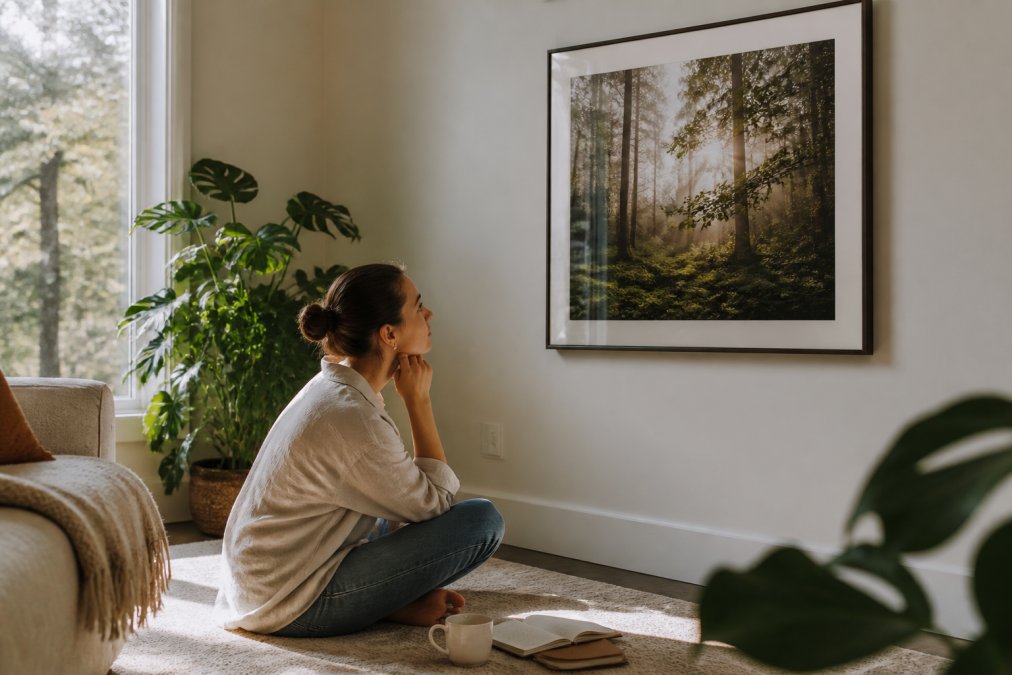
If nothing happens in a minute, that is your answer. If something happens, pay attention to what. A photograph of a still butterfly on a branch may not be dramatic, but it can create a sense of quiet that a bold abstract never would.
The psychology here matters more than most guides admit. Trends are external and temporary. Authenticity is internal and durable. A piece chosen for a trend will feel dated within a season. A piece chosen for resonance tends to deepen.
Tips for Buying Original Fine Art Photography
Buying original fine art photography is simpler than most people expect, provided you know what to check. Start with the print itself, then the story behind it, then the practical details.
Ask these questions before you buy:
- Is this an original work by a named artist, or a licensed stock image?
- What is the edition size, and is it numbered?
- What paper or material is it printed on, and how does that affect the image?
- How is it shipped, and is it protected in transit?
- What is the return policy if it does not resonate in person?
That last question matters more than buyers think. You cannot always predict how a piece will feel in your own light.
Read the Artist's Story Before You Buy
A photograph made with intention carries that intention into the room. A stock image does not, no matter how pretty it is.
Read the artist's statement. Look for a specific moment, a specific walk, a specific reason the frame was made. Magick Brush pieces, for example, are created by artist and mentor Erin D'Elia and each carries a written account of the moment behind it, from a butterfly resting on a branch to the ridges of an old tree.

If the story is vague or missing, treat that as information. Originality is not just about the file. It is about the person who made it.
How to Display Art That Tells a Story
Art that tells a story is displayed with intention, not scattered. The goal is visual harmony: the piece, the wall, the light, and the room all agreeing.
A few practical rules:
- Hang at eye level, roughly 57 to 60 inches from the floor to the center of the frame (nga.gov).
- Give the piece breathing room. Crowding kills visual impact.
- Match the light. Warm bulbs flatter warm tones; daylight flatters cool tones.
- Group related works rather than mixing unrelated styles on one wall.
- Let one piece anchor the room instead of hanging five competing ones.
If you want a room to feel like a sanctuary, one strong piece beats a gallery wall every time.
Authentic Art on a Real Budget
Authentic curation does not require a large budget. It requires patience and a clear eye. The gap in most advice on this topic is that it treats "affordable" and "authentic" as opposites. They are not. What they require is a different set of sourcing channels than the ones most buyers default to.
Three Channels Most Buyers Never Check
Thrift stores and estate sales. Original work shows up here constantly, usually because a previous owner downsized or a family did not know what they had. Look for a signature, an edition number, or a gallery label on the back. A hand-signed print or a small original painting can surface for the price of a mass-produced canvas. The trade-off is time: you have to go often, and you have to be willing to walk away empty-handed.
Local markets and open studios. Regional art walks, farmers markets with a craft section, and annual open-studio weekends put you in front of working artists directly. Prices are usually set for local buyers, not gallery buyers, and you can talk to the person who made the work. The trade-off is selection: you are limited to whoever showed up that weekend.
Emerging artists online. Artists in the first few years of a public practice often price work accessibly while they build a collector base. Look for a consistent body of work, a clear artist statement, and a documented process. The trade-off is risk: an emerging artist's market value is unproven, so buy because the work moves you, not because you expect it to appreciate.
The One-Meaningful-Piece Rule
Three budget-conscious strategies that work regardless of channel:
- Buy one meaningful piece instead of three generic ones. A single work chosen for resonance anchors a room better than a wall of filler.
- Choose smaller sizes and hang them in a tight, intentional grouping. A small print in a generous mat and frame reads as deliberate, not cheap.
- Buy directly from the artist where possible, so your money goes to the work rather than a middleman.
What to Check Before You Spend
Budget sourcing has its own risks, and a few checks protect you:
- Condition. Foxing, water stains, fading, and acidic matting all worsen over time (loc.gov). Ask about framing materials, and budget for a re-frame if the mat is not archival.
- Signature and edition. A pencil signature and an edition number (for example, "12/50") signal a limited run. An open-edition reproduction does not carry the same weight.
- Provenance. A gallery label, receipt, or artist note tells you where the piece has been. Missing provenance is not automatically disqualifying, but it should lower the price you are willing to pay.
- Return policy. You cannot always predict how a piece will feel in your own light. A seller who accepts returns is worth more than a small discount.
The trade-off across all three channels is real: fewer options, sometimes longer shipping, and more legwork. For most buyers, that is a fair exchange for art that actually means something. Buy slowly, buy meaningfully, and let the collection grow.
When Your Taste Changes (And It Will)
Your taste will change. That is not a failure of curation. It is evidence that curation is working.
The people who struggle most with art are the ones who treat a purchase as permanent. The people who thrive treat their walls as a living collection. They rotate pieces, move them between rooms, and let some rest in storage for a season.
This is the evolution of taste, and it is normal. A photograph that felt essential in a first apartment may feel too quiet in a house with children. A piece you bought for a home office may belong in a bedroom five years later.
The practical move is to buy slowly, buy meaningfully, and expect to rearrange. A small, well-chosen collection that grows over years will always beat a fast one assembled in a weekend.
Conclusion: Authentic Art Is a Practice, Not a Purchase
The hardest part of choosing art is trusting your own response over the noise of trends, algorithms, and other people's opinions. That takes practice, and it takes permission to buy slowly.
Magick Brush exists for exactly that kind of buyer. Our curated collections, including Butterfly, The Living Bloom, Earth Memory, and Thresholds & Tides, are fine-art photography made to anchor a space and invite a deeper breath. Each piece is created by Erin D'Elia with a real story behind it, printed for spaces meant for rest, healing, and reflection.
Get started with Magick Brush and find the one piece your room has been waiting for.
Frequently Asked Questions
How do I know if a piece of art is right for my home?
Live with it mentally before you buy. Save the image for a week and notice whether you keep returning to it. Check whether it fits the room's light, scale, and mood. A piece that supports the feeling you want in that space, calm, focus, or warmth, usually belongs there. If it only matches the sofa, keep looking.
What makes art feel authentic rather than generic?
Authentic art connects to your values and story, not just a trend. Generic decor is chosen to fill space; authentic art is chosen because it means something. Ask whether the piece reflects a real part of you, a memory, a place, or a feeling. If the answer is yes, it will read as personal even to guests who never ask why.
How do I start an art collection on a budget?
Start with one meaningful piece instead of three forgettable ones. Original fine art photography prints from independent artists often cost less than mass-produced decor and carry a real story. Set a per-piece budget, buy slowly, and let each addition earn its place. A small, intentional collection beats a wall of filler every time.
Should art match the furniture in a room?
Match the mood, not the upholstery. Art that echoes your sofa's exact colors can feel flat. Instead, look for visual harmony: shared undertones, complementary textures, or a subject that fits the room's purpose. A black and white nature print can sit happily above a colorful chair because the contrast feels deliberate rather than accidental.