

Benefits of Biophilic Design for Mental Health
Table of Contents
- What Biophilic Design Does for Mental Health
- Biophilic Design and Stress Reduction: What the Research Shows
- How Biophilic Design Supports Cognitive Function and Focus
- Biophilic Design Ideas for the Home That Actually Work
- The Benefits of Nature Photography Indoors for Emotional Wellbeing
- What the Evidence Can and Cannot Tell You
- Making Biophilic Design Accessible, Affordable, and Measurable
- Conclusion: Bringing Nature In, One Intentional Choice at a Time
- Frequently Asked Questions
Last Updated: October 12, 2026
What Biophilic Design Does for Mental Health
Biophilic design is the practice of shaping indoor spaces to reflect the patterns, materials, and light of the natural world. The benefits of biophilic design for mental health come down to one idea: a space that echoes nature gives the nervous system somewhere to rest. This guide from Magick Brush walks through what the research suggests, what it cannot yet prove, and how to bring these ideas into a home without a renovation budget.
The Human Pull Toward Nature
Most of us can name the feeling. Step onto a trail after a week indoors and something in the shoulders drops.
That response is often called biophilia, the idea that humans carry an innate pull toward living systems. It does not require a forest.
What most guides miss is that the pull is sensory, not symbolic. A nature poster with no texture or light does very little.
Biophilic Design and Stress Reduction: What the Research Shows
The clearest claims in this field concern stress and recovery, not cure. Research on nature exposure and indoor environments generally points to lower self-reported stress, calmer mood, and faster recovery from demanding tasks when people can see or sense natural elements. research on nature contact and health outcomes Much of this work studies outdoor nature, so indoor applications rest on reasonable inference rather than direct proof.
Where the evidence is stronger: views of greenery, daylight, and natural materials tend to be associated with lower reported stress and better mood in workplace and healthcare settings. Where it is weaker: how much a single photograph or one plant changes a stress marker over months. Anyone promising a fixed number is selling something.
How Biophilic Design Supports Cognitive Function and Focus
Attention restoration theory offers the most useful frame here. It suggests that natural stimuli engage the mind gently, letting directed attention recover after periods of hard focus.
The mechanism matters because it explains which design moves actually help.
That distinction gives you a practical test for any biophilic change: does it invite the eye to wander, or does it grab and hold? A window with moving leaves passes.
Which Interventions Help Focus Most
Not every intervention works equally on attention. Based on the pattern across workplace and school studies, here is a rough ranking of what tends to move the needle for focus:
- Daylight on the work surface. The strongest and most consistent factor. Light reaching the desk supports alertness and mood, and it is the one change most people can make without spending anything.
- A view of greenery. Reliable in workplace studies, though the effect depends on view quality. A parking lot does not substitute for trees.
- Natural materials within reach. Wood and stone surfaces appear to support a calmer, less effortful state, though the evidence is thinner than for light and views.
- Indoor plants. Helpful, but often overstated. One healthy plant in view does more than a crowded shelf, and a struggling plant can read as clutter.
- Nature sounds. Useful in open offices and shared spaces where visual privacy is limited, but they can distract some people. Test before committing.
A Focus-First Setup
If focus is your goal, sequence the changes:
- Turn your desk so daylight reaches it, and clear the window.
- Put one living element in your direct line of sight, not behind you.
- Add one natural texture within arm's reach.
- Leave one quiet, uncluttered area the eye can rest on.
None of these require a new room. A desk turned ninety degrees toward a window, with one living element in view, does more for mental clarity than a wall of generic decor.
Biophilic Design Ideas for the Home That Actually Work
The best home interventions are cheap, reversible, and easy to maintain. Renters can do all of them, and none require structural work.
Start With Light, Then Add Living Elements
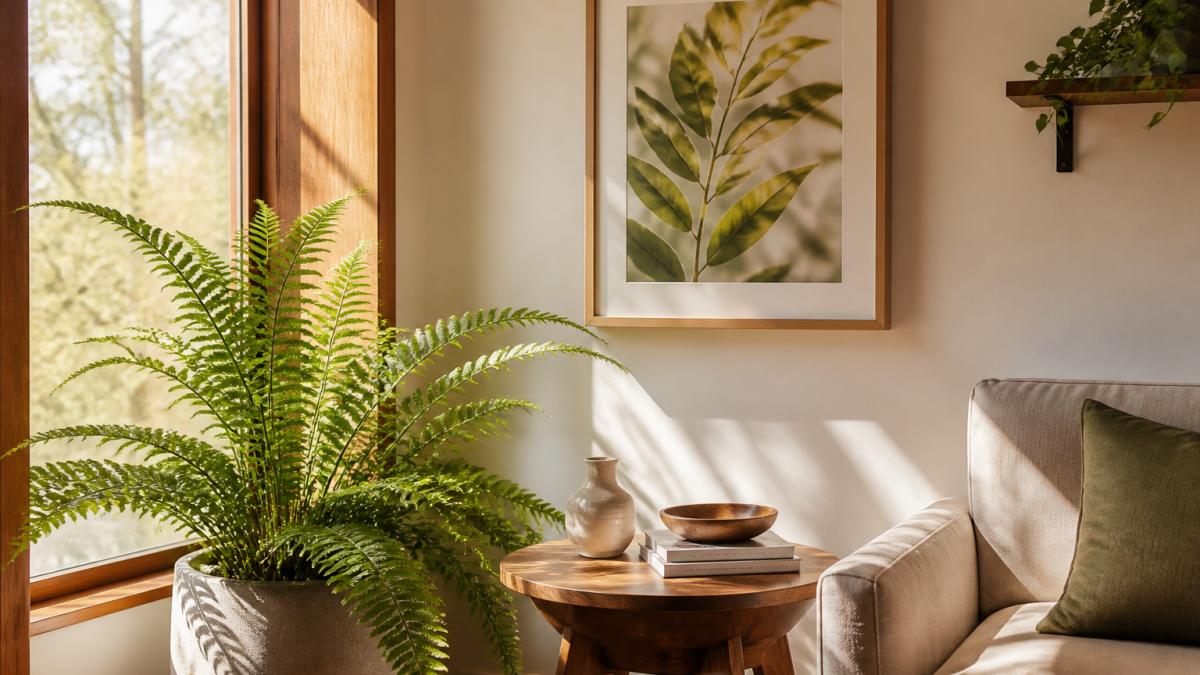
Light first, always. Move furniture so daylight lands where you sit, keep windows clear, and use warm bulbs after dark. Then add living elements: one plant you will actually water beats five you will not. A pothos, a snake plant, or a small fern each handle low light and irregular care.
Choose Natural Materials and Textures
Swap one synthetic surface for a natural one. A linen curtain, a wooden tray, a wool throw, a stone bowl. Texture is what the hand reads as real, and it is often what makes a room feel grounded rather than staged.
| Change | Effort | Ongoing Care | Best For |
|---|---|---|---|
| Reposition seating for daylight | Low | None | Any room, renters included |
| Add one low-light plant | Low | Watering every 1-2 weeks | Desks, bedrooms, corners |
| Swap one synthetic textile | Low | Occasional washing | Living rooms, bedrooms |
| Add nature photography | Low | Dusting | Small or minimalist spaces |
| Install a living green wall | High | Regular watering, pruning | Commercial or large spaces |
The Benefits of Nature Photography Indoors for Emotional Wellbeing
Nature photography indoors works on the same visual channel as a window, and that is the point.
This is where Magick Brush fits. Our fine-art photography is made by artist Erin D'Elia, whose pieces translate the quiet moments between things: a leaf curling toward its own center in The Inward Spiral, a path softened by grass and shadow in The Green Passage.


For a small, modern home office, a single botanical print often does more than a gallery wall. It anchors the eye, softens a hard-edged room, and reminds the viewer that beauty and nature still matter.
What the Evidence Can and Cannot Tell You
Honest framing matters more here than anywhere else . The evidence for biophilic design and mental health is promising but uneven, and the field has real limitations.
What the research supports reasonably well: nature views, daylight, and natural materials are associated with lower reported stress and better mood in workplaces and care settings.
There are also risks worth naming. Some people find certain natural patterns overstimulating rather than calming, and a busy green wall can read as clutter in a small room.
Making Biophilic Design Accessible, Affordable, and Measurable
Access comes before aesthetics. If a design idea only works for homeowners with a renovation budget, it is not a mental health strategy; it is a decorating trend. Most guides skip this entirely, which leaves out the people who need it most: renters, people with limited mobility, people who cannot get outdoors, and people whose sensory needs make a busy green wall feel like noise rather than calm.
Access and Sensory Needs
A nature experience does not have to be visual, and it does not have to be outdoors. For people who cannot use outdoor spaces, the indoor channel is the whole point. Useful options include:
- Tactile. A wool throw, a smooth stone, a wooden tray. Touch is often the most accessible nature cue and the least discussed.
- Auditory. A small fountain or a nature soundscape. Helpful for some, distracting for others, so treat it as a personal test.
- Olfactory. A cedar or eucalyptus element, used sparingly. Strong scents can trigger sensitivities, so keep it optional.
- Visual. A print with depth, a plant, a window. The most common channel, but not the only one.
Sensory needs differ, and a space that soothes one person can agitate another. Some people find certain natural patterns overstimulating. A dense green wall can read as clutter in a small room. Neurodivergent readers in particular may find that fewer, larger, calmer elements work better than many small ones. Treat any design choice as a hypothesis about your own response, not a universal rule.
Affordability Without Compromise
The lowest-cost changes are often the highest-impact. Repositioning a chair toward a window costs nothing. One low-light plant, a linen curtain, or a single archival print costs far less than a remodel and often changes the room more. The mistake is buying a large plant collection before you know your light conditions.
Maintenance is the hidden cost. Living walls and large plant collections demand regular watering and pruning. Choose the level of upkeep you will genuinely sustain, not the level that looks best in a photograph.
How to Measure Whether It Is Working
You do not need a lab to know if a change helped. You need a simple before-and-after. Track three things, once a week, in a note on your phone:
- Use. How often do you actually sit in the space?
- Mood. How do you feel after ten minutes there?
- Attention. Can you focus there longer than you could before?
These are not clinical measures, and they are not interchangeable with them. Perceived stress, mood, and attention are different things, and a good feeling in a room is not the same as a treated condition. What they can do is tell you whether a specific change is worth keeping. Change one variable at a time. Add a plant, live with it for two weeks, then add light or art. Stacking five changes at once tells you nothing about which one helped.
Conclusion: Bringing Nature In, One Intentional Choice at a Time
The gap between a room that drains you and one that restores you is usually smaller than people expect. It is often a chair turned toward the window, one plant that survives, and one image with enough depth to hold your attention.
At Magick Brush, we make fine-art photography for exactly that purpose: nature-inspired pieces designed for healing spaces, homes, and studios.
Frequently Asked Questions
What are the mental health benefits of biophilic design?
Biophilic design connects indoor spaces to nature through light, plants, natural materials, and nature views. Research links these elements to lower stress levels, reduced anxiety, improved mood, and better attention. A workplace or home with natural light, greenery, and wood surfaces can help you feel calmer and more focused. The benefits come from repeated, gentle exposure rather than a single fix, so small consistent changes matter more than one dramatic overhaul.
Does looking at nature images have mental health benefits?
Yes. Studies on nature exposure suggest that even viewing photographs of natural scenes can support attention restoration and lower stress. The benefits of nature photography indoors come from giving your eyes a soft, non-demanding focal point that invites a slower breath. A fine-art print of a forest path or curling leaf can serve as a visual anchor in a meditation corner, home office, or bedroom, reminding you to pause without requiring you to leave the room.
What is the difference between biophilic design and adding houseplants?
Houseplants are one element of biophilic design, not the whole practice. Biophilic design also includes natural lighting, views of green space, natural materials like wood and stone, sensory engagement through texture and scent, and spatial layouts that mimic natural patterns. Adding a plant helps, but combining it with daylight, a nature view, and organic materials creates a more complete environment. The goal is a space that feels alive and grounded, not just decorated with greenery.
Can biophilic design replace mental health treatment?
No. Biophilic design is a supportive environmental practice, not a substitute for professional care. It can reduce everyday stress and improve focus, but it does not treat clinical anxiety, depression, or other conditions. Think of it as one layer of a broader wellbeing routine that may include therapy, movement, sleep, and social connection. If you are struggling, talk to a licensed mental health professional. Design can support healing, but it cannot do the work of treatment.