

Intentional Decor for Rented Apartments: A 2026 Guide
Table of Contents
- Why Intentional Decor Changes How a Rental Feels
- Renter-Friendly Wall Decor Ideas That Leave No Trace
- Non-Permanent Apartment Upgrades That Feel Built-In
- Curating a Home with Fine Art in a Rental
- Designing for Sound, Scent, and the Senses
- What Your Lease Actually Allows
- Choosing with Intention, Not Impulse
- Conclusion: Making a Rental Feel Like Yours
- Frequently Asked Questions
Last Updated: September 11, 2026
Why Intentional Decor Changes How a Rental Feels
Intentional decor for rented apartments means choosing every object on purpose, so the room reflects your inner life rather than a landlord's beige default. At Magick Brush, we've watched renters trade impulse buys for fewer, better pieces and describe the result the same way: the room finally breathes.

A space assembled by accident reads as temporary; one assembled with care signals safety, and safety is what lets you rest.
Renter-Friendly Wall Decor Ideas That Leave No Trace
The best renter-friendly wall decor ideas use removable materials that come down clean when you move, impact without residue.
Peel-and-Stick Wallpaper and Removable Accent Walls
Peel-and-stick wallpaper turns one wall into a focal point in an afternoon and lifts away when you leave. Choose a single accent wall rather than a whole room; it reads more deliberate and reduces adhesive failure on textured or freshly painted surfaces. Test a small square first, wait a week, then commit.
Adhesive Hooks, Command Strips, and Tension Rods
Adhesive hooks, Command strips, and tension rods carry most of a damage-free setup. Follow the package weight rating, clean the surface with rubbing alcohol, and let the strip sit an hour before hanging anything. Tension rods handle curtains and in-cabinet shelves with no drilling.
Non-Permanent Apartment Upgrades That Feel Built-In
Non-permanent apartment upgrades feel built-in when they change what your eye lands on first: hardware, light, and windows, all reversible in under an hour.
Hardware Swaps, Lighting, and Window Treatments
Cabinet knobs and drawer pulls are the fastest swap in a rental kitchen. Keep the originals in a labeled bag and reinstall them before your walkthrough. Swap switch plates too; a plain plastic cover reads builder-grade, a metal one does not.
Lighting changes more than almost anything else. Overhead fixtures flatten a room, so add floor and table lamps at different heights. For windows, tension rods and removable brackets hold curtains without holes, and a longer panel makes a low ceiling feel taller.
Temporary Flooring and Space-Saving Storage
Area rugs are the renter's flooring. A rug large enough to sit under the front legs of your sofa ties a seating area together and hides whatever carpet you inherited. For storage, go vertical: over-the-door racks, stackable bins, and multifunctional furniture like a storage ottoman.
| Upgrade | Effort | Reversible? | Biggest Payoff |
|---|---|---|---|
| Hardware swap | 30 minutes | Yes | Kitchen and bath feel custom |
| Floor and table lamps | Under an hour | Yes | Warmer ambient lighting |
| Tension-rod curtains | 20 minutes | Yes | Softer windows, taller ceilings |
| Area rug | Immediate | Yes | Defines the layout |
| Vertical storage | 1-2 hours | Yes | Clears visual clutter |
Curating a Home with Fine Art in a Rental
Curating a home with fine art in a rental comes down to one decision: fewer pieces, chosen slowly, hung where you actually look. One original photograph above a sofa does more than six prints bought in an afternoon.
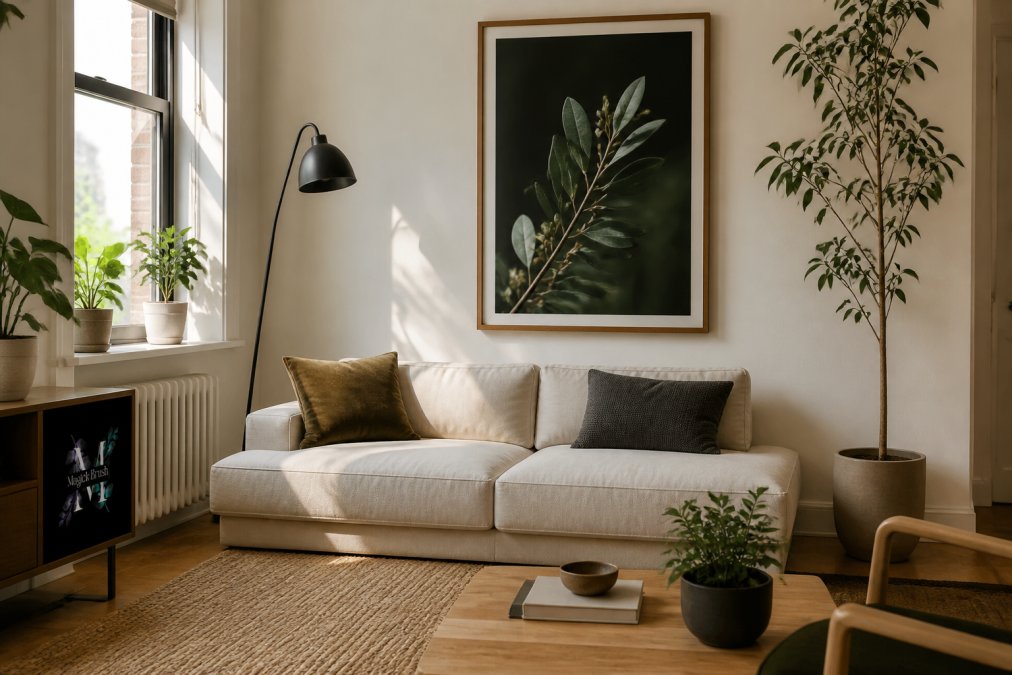
This is where Magick Brush fits naturally. Our fine-art photography is made to soften a room and anchor the eye, and each piece is created by artist and mentor Erin D'Elia rather than licensed from a stock library. For a rental, choose pieces that travel well and hang them with removable strips so nothing follows you out the door. If you're weighing a single larger work against several small ones, one American Institute for Conservation guidance on framing and displaying works on paper worth of care about hanging and light protection applies to any print you buy.

Designing for Sound, Scent, and the Senses
Designing for sound, scent, and the senses is the layer most renters skip, and it's the one that makes a room feel finished. Vision gets all the attention; the other senses decide whether you actually relax. Every choice should answer how you want the room to feel, not just how it should look.
Sound: Softening a Hard Rental
Hard floors, bare drywall, and hollow-core doors bounce sound, which is why so many rentals feel loud even when they're quiet. The fix is absorption, and it's renter-friendly because it's almost entirely textile-based.
- Rugs and pads. A rug with a felt or rubber pad absorbs far more than a bare rug. Cover the largest continuous floor area you can; a rug that floats in the middle of a room does less than one reaching under the front legs of your seating.
- Curtains. Fabric window panels, not vinyl blinds, break up reflections at the wall, where echo lives. Floor-length panels do more than sill-length ones.
- Soft furniture and bookshelves. An upholstered chair, a loaded bookshelf, and a fabric headboard each act as a diffuser. A room with none will always sound hollow.
- Doors and gaps. A draft stopper under a door reduces both sound transfer and hallway smell. It's one of the cheapest sensory upgrades available.
Renters often buy a rug for looks, then wonder why the room still echoes. The pad is the part doing the acoustic work.
Light Temperature: The Setting Nobody Adjusts
Most renters inherit overhead fixtures with cool-white bulbs, which read clinical and flatten skin tones. Bulb color is measured in kelvin, and the difference between a 2700K bulb and a 5000K bulb is the difference between a living room and a break room (energy.gov).
- Warm light (around 2700K) for living rooms, bedrooms, and anywhere you want to unwind.
- Neutral light (around 3000K-3500K) for kitchens, bathrooms, and task areas where you need to see clearly.
- Layered height. One ceiling fixture gives flat, top-down light. A floor lamp, a table lamp, and a small accent light at three heights create the pools of light that make a room feel designed.
- Dimmers where possible. A plug-in dimmer or a smart bulb lets you drop the intensity at night without rewiring anything.
Swapping bulbs is the single fastest sensory change in a rental, and the original bulbs go back in the box at move-out.
Scent and Texture: The Finishing Layer
Scent gives a room a signature, but open flames are a bad fit for rentals with smoke detectors, pets, or forgetful occupants. A diffuser, simmer pot, or linen spray delivers the same effect with no fire risk and no soot.
Texture separates a curated space from a staged one. A wool throw, linen curtains, a wooden tray, a ceramic bowl, and a woven basket all read as lived-in rather than showroom. The test: if you removed the color, would the room still feel warm? If not, it's relying on pattern instead of texture.
The Sensory Walkthrough
Before you buy anything else, stand in the doorway of each room and run this sequence:
- Close your eyes and listen. Is there an echo? If yes, add textile.
- Look up at the light. Is it cool white? Swap the bulb.
- Notice the light height. Is everything coming from the ceiling? Add a lamp at a lower level.
- Breathe in. Does the room smell like nothing, or like something you chose?
- Touch three surfaces. If they're all smooth and synthetic, add one natural material.
This takes about five minutes per room and costs far less than replacing furniture.
What Your Lease Actually Allows
Your lease decides what you can change, so read it before you buy anything. Most standard leases address alterations, adhesives, and wall damage in specific language, and rules vary widely by building, landlord, and state. The goal isn't to scare you out of decorating, it's a repeatable process so you can decorate confidently and get your deposit back.
The Three Clauses That Matter
You can skim most of a lease. These three sections govern decor:
- Alterations. This clause defines what counts as a change to the unit. Some leases define alterations narrowly (structural changes, painting, flooring) and leave small hanging hardware alone; others define it broadly enough to include adhesive hooks. Read the definition, not just the heading.
- Damage and wear. This clause distinguishes normal wear and tear from damage. Small nail holes from picture hanging are commonly treated as normal wear; a peeled paint patch from an aggressive adhesive is commonly treated as damage (hud.gov). That distinction decides your deposit.
- Entry and inspection. This clause tells you how much notice your landlord must give before entering, and how much time you'd have to reverse a change if a repair visit is scheduled.
If your lease is silent on a specific change, that silence is not automatic permission. It usually means the decision falls to the landlord's discretion, which is why the next step matters.
The Written-Permission Script
When a clause is ambiguous, ask in writing and keep the reply. A short, specific message gets a faster, more useful answer:
"Hi [name], I'd like to hang a few framed pieces in the living room using removable adhesive strips rated for the weight. I'll remove them and any residue before move-out. Is that acceptable under the lease? Happy to send a photo of the product if helpful."
Three things make this work: it names the product category, states your intent to restore the wall, and invites a yes/no answer. A written confirmation that removable strips are fine is worth more at move-out than any memory of a hallway conversation.
The Move-In Photo Protocol
This is the step most renters skip and most regret. Before you hang a single thing:
- Photograph every wall in every room, including closets and behind furniture. Use good lighting and take wide shots plus close-ups of any existing marks.
- Photograph the floors, counters, and fixtures the same way.
- Note the date and email the photos to yourself or your landlord so there's a timestamped record.
- Repeat the process at move-out, after you've removed everything and before the walkthrough.
A dated before-and-after set is the single most effective protection for your deposit, because it settles whether a mark was yours or pre-existing.
What to Negotiate Before You Sign
If you're still apartment hunting, the strongest moment to negotiate decor flexibility is before you sign. Landlords are more flexible when filling a unit. Reasonable asks include:
- Permission to paint, with the understanding that you'll repaint to the original color at move-out.
- Permission to hang with small nails, provided you patch and touch up.
- A written list of approved adhesive products.
- Clarification on who pays for patching supplies.
Get any agreement added to the lease or confirmed in writing. A verbal yes from a leasing agent who no longer works there is worth nothing.
When to Walk Away from a Change
Some leases prohibit adhesives on painted surfaces outright, and some buildings have historic or specialty finishes where any adhesive risks pulling the surface. In those cases, skip the wall entirely and put your energy into layers that carry no risk: lighting, rugs, tension-rod curtains, freestanding shelving, and leaning art on a console or floor. A leaning framed piece is fully reversible and often reads more deliberate than a hung one.
Choosing with Intention, Not Impulse
Choosing with intention, not impulse, separates a room you love from a room you tolerate. Impulse buying fills space; intentional buying shapes it.
Try this before your next purchase:
- Name the feeling you want in that spot. Calm? Focus? Warmth?
- Wait a week. If you still want it, it's not an impulse.
- Measure the wall and check the scale against your furniture.
- Ask whether it will survive one move.
- Choose one piece that anchors the space instead of five that fill it.
A common mistake is buying decor to solve boredom rather than to solve a room. The first purchase gets returned. The second one stays for years.
Conclusion: Making a Rental Feel Like Yours
The hardest part of renting is accepting that a space you don't own can still be a space you shape. It can, and the work is smaller than it looks: a removable accent wall, a hardware swap, one piece of art that means something, and a rug that defines the room.
Magick Brush exists for exactly that moment. Our fine-art photography is nature-inspired and made for healing spaces, homes, and studios, with collections including Butterfly, The Living Bloom, Earth Memory, and Thresholds & Tides. Each piece is designed to invite a deeper breath and a sense of presence, and every one is original work by Erin D'Elia.
Continue shopping with Magick Brush and choose the piece that anchors your rental, then hang it with strips and take it with you when you go.
Frequently Asked Questions
How can I decorate my apartment without damaging the walls?
Stick to removable methods: adhesive hooks and strips rated for the weight of your piece, tension rods inside window frames, and peel-and-stick wallpaper on smooth, painted surfaces. For heavier art, lean framed prints on a console or shelf instead of hanging them. Always test adhesive on a hidden patch first, and remove strips slowly by pulling the tab straight down. These approaches keep your security deposit safe while still letting you shape the room.
Can I use fine art in a rental apartment?
Yes, and it is often the easiest upgrade you can make. Fine art is portable, so it moves with you, and it does not alter the unit. A single framed print above a sofa or desk can anchor the eye and set the tone for the whole room. Choose one piece that genuinely moves you rather than filling walls with filler, and let the rest of the decor stay quiet around it.
What are some non-permanent ways to upgrade rental lighting?
Swap the shade on an existing fixture, add a floor lamp with a warm bulb near a reading chair, and use plug-in sconces that mount with adhesive strips. Layer light at three heights: overhead, mid-level (table or floor lamps), and low (a small lamp on a shelf). Warm bulbs around 2700K make a rental feel calmer than cool white, and every change reverses in minutes when you move out.
How do I balance budget-friendly decor with intentional design?
Spend on the pieces you look at every day and save on the rest. One meaningful artwork, a good lamp, and a washable area rug do more for a room than a cart full of small accessories. Thrift or resell what you tire of, and buy slowly. Intentional decor is less about the total spent and more about whether each object earns its place in the room.